Window Coverings
Blinds Couture
A window covering company that replaced its entire software stack with one platform it owns
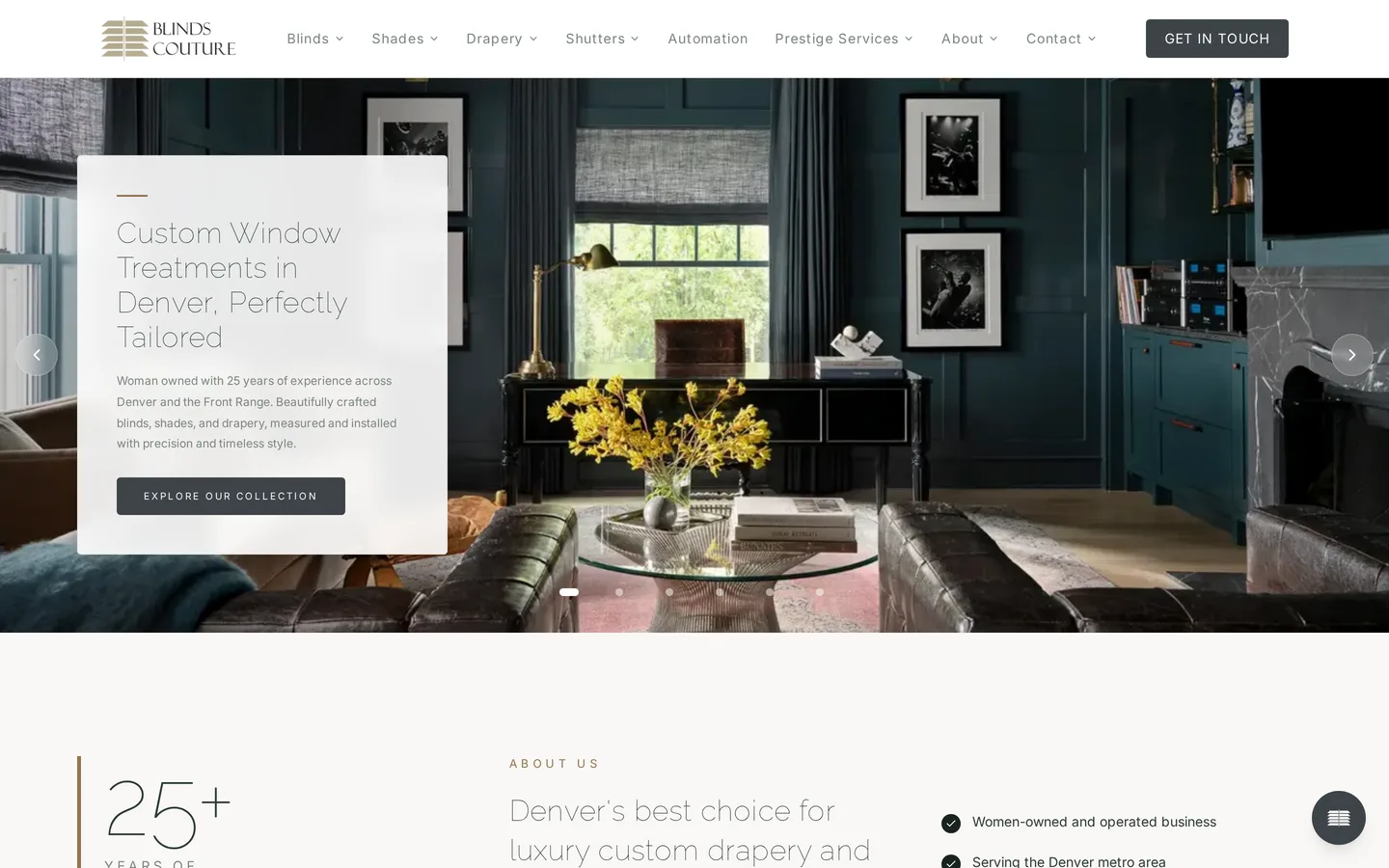
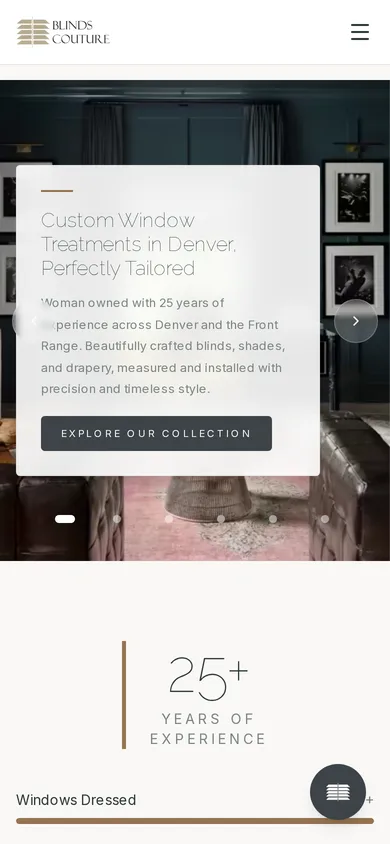
Blinds Couture came to us for a website. What shipped was a full operating system for a custom window covering business: a trade CRM, a deals pipeline, a booking engine with live availability, warranty claims, estimate-to-invoice approval, vendor document tracking, and two AI assistants, all sharing one database with the public site.
A custom window covering business runs on quotes, measurements, installs, and warranty claims, and most of them run each of those on a different tool. A CRM here, a scheduling app there, invoicing somewhere else, warranty claims in an inbox. Every seam between those tools is a place where a job falls through and a customer gets a phone call nobody can answer.
The brief
What the engagement had to deliver
Blinds Couture came to us with a clear set of outcomes rather than a page count. Everything below was agreed before design started.
- Rebuild the public site to a standard that matches the price point of the product
- Replace the disconnected tool stack rather than adding another tool to it
- Put booking, quoting, installing, invoicing, and warranty claims on one spine
- Give the team leverage without adding headcount
Key challenges
What made this build harder than a template
- Every module had to work standalone and also share state, because a booking becomes a job becomes an invoice becomes a warranty record
- Trade customers and retail customers behave differently and needed different pipelines without two systems
- Live availability is unforgiving. A booking engine that shows a slot that is not actually free is worse than no booking engine
- Warranty claims carry attachments and history, which means storage, permissions, and retention all had to be right from the start
Our approach
How we built it
We built the public site and the operating system as one project rather than a marketing site bolted to a SaaS subscription. That single decision is what makes everything downstream possible. A quote generated in the pipeline becomes an invoice without a re-key. A booking taken on the public site lands in the same calendar the install team works from. A warranty claim attaches to the job record that produced it. Two AI assistants sit on top of the same data, one facing customers on the site and one facing staff inside the console. Nothing syncs, because there is nothing to sync between.
The front end
What visitors see
- Full public marketing and product site for a premium window covering brand
- Customer-facing booking flow reading live availability from the same calendar the crew works from
- Customer portal for job status, documents, and warranty claims
- AI chat assistant answering product and process questions on the public site
- Full mobile treatment across the marketing surface and the portal
The back end
What the business runs on
- Trade CRM with a deals pipeline separating trade and retail customers
- Project and job management carrying a booking through install to completion
- Booking engine with live availability, not a request form
- Estimate to invoice approval flow with Stripe payment collection
- Warranty claims with file attachments and full history against the originating job
- Vendor document tracking with expiry alerting
- Staff production leaderboard built from real job completion data
- Internal password vault for shared operational credentials
- Second AI assistant scoped to staff, operating on internal data
- Row level security on every table, roles separating staff, trade, and retail access
The stack
What it is built on
- TanStack Start
- React 19
- Tailwind v4
- shadcn/ui
- Lovable Cloud
- Stripe
Results
What changed
- One owned platform replacing a stack of subscriptions the business did not control
- Booking, job, invoice, and warranty all reading from a single record with no re-keying
- Trade and retail served by one system without either pipeline being compromised
- An operating system that appreciates as an asset instead of renewing as a liability
Since launch
Where the new enquiries come from
Window coverings is a considered purchase with a lot of confusing product language. Since the rebuild, Blinds Couture reports enquiries that already use the correct product vocabulary and already know the service is consultative, because an assistant summarised it for them first.
What the client reports
- Consultation requests naming specific product families rather than asking what the options are
- Homeowners arriving with a budget range in mind, having asked an assistant what this work costs
- Assistant referrals appearing alongside local search in how-did-you-find-us answers
- Less education needed on the first visit, so appointments convert further along
Why an answer engine can quote this site
- Product and service explanations written to stand alone, in the words a homeowner uses
- One clear page per intent rather than one long page that answers nothing specifically
- Server-rendered pages with real headings, so an extractor can find the answer to a narrow question
- Local context stated explicitly instead of implied by a footer address
The points above are what the owner tells us, not analytics we audited on their behalf. We publish them as reported rather than dressing them up as measured numbers.
Common questions
Questions about the Blinds Couture build
Can a small business really replace its whole software stack with one custom platform?
Yes, when the business has a clear operational shape. Blinds Couture runs quoting, booking, install management, invoicing, and warranty claims on one database. The reason most businesses cannot is not technical, it is that they bought tools before they mapped the workflow.
What does it cost to run a custom platform versus a stack of subscriptions?
A custom platform has a build cost and then a hosting cost measured in tens of dollars a month. A subscription stack has no build cost and a bill that grows with every seat, every module, and every renewal, forever, on someone else's pricing decisions.
Why put the website and the business software in the same project?
Because the seam between them is where the work gets lost. A booking taken on the site that has to sync into a separate scheduling tool will eventually fail to sync. If they are the same database, there is no sync to fail.
- Services
- Website, Business OS, Client Portal, Booking, AI
- Sector
- Window Coverings
- Client
- Blinds Couture
- Build window
- Phased build
Capabilities used
What this platform runs on
Building something similar in this sector? See the window coverings platform guide, or read how a custom business operating system fits together, then book a discovery call.
Related work
Other platforms we have built
Metal Fabrication
Roseworks Fabrication
Roseworks Fabrication needed a site that treated custom metalwork as craft rather than as a commodity trade listing. It was built on the same design foundation as Blinds Couture, which let a proven premium system carry a second trade brand without starting over.
Underground Utilities
Denver Sewer and Water
Denver Sewer and Water is a privately owned family underground line company in Denver. It is not affiliated with Denver Water or the City and County of Denver, and a large part of the site's job is making that clear while still winning the searches those names dominate.
Construction Safety
S.O.S. Solutions
S.O.S. Solutions is a multi-tenant safety management platform for construction companies. Crews complete pre-task plans, toolbox talks, inspections and incident reports from the job site, and the company gets a documentation trail that holds up when someone asks for it.
Want a site that works this hard for your business?
Bring us the workflow you are tired of duct taping together. We will show you what it looks like as one owned platform.