Construction Safety
S.O.S. Solutions
Construction safety documentation that gets filled out in the field instead of reconstructed on Friday
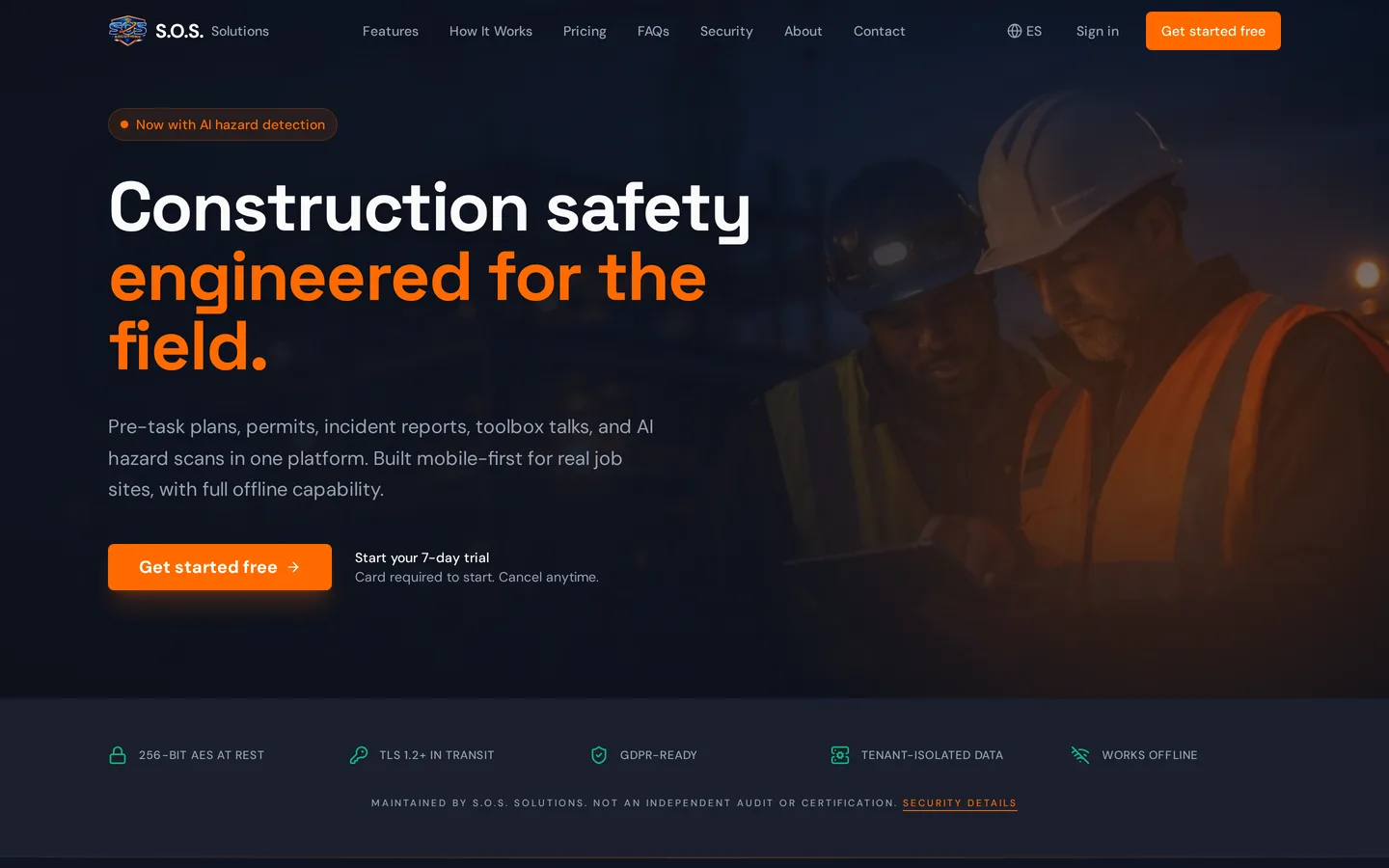
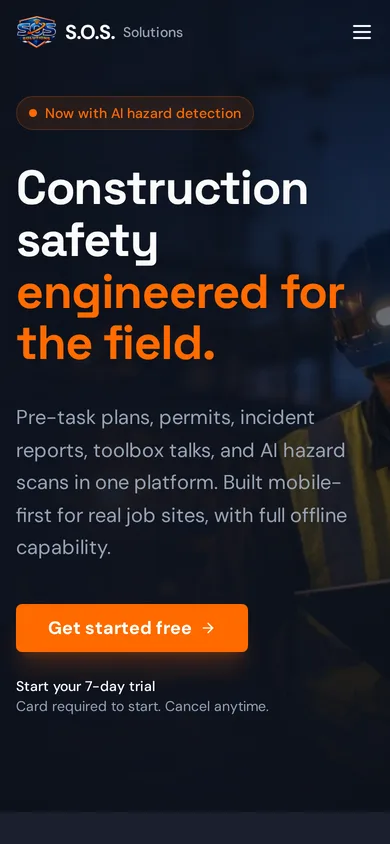
S.O.S. Solutions is a multi-tenant safety management platform for construction companies. Crews complete pre-task plans, toolbox talks, inspections and incident reports from the job site, and the company gets a documentation trail that holds up when someone asks for it.
Safety paperwork is done twice on most job sites. Once badly in the moment, and once properly on Friday afternoon when someone reconstructs the week from memory to satisfy a compliance file. The second version is the one that gets audited, and it is the one that is least true.
The brief
What the engagement had to deliver
S.O.S. Solutions came to us with a clear set of outcomes rather than a page count. Everything below was agreed before design started.
- Move safety documentation onto the phone that is already in the worker's pocket
- Cover the full documentation set rather than one form: pre-task plans, toolbox talks, safety data sheets, inspections, incidents, and stop-work authority
- Make it multi-tenant so construction companies subscribe individually and never see each other's data
- Handle subscription billing without a separate finance tool
Key challenges
What made this build harder than a template
- Field workers will abandon any form that takes longer than the paper it replaces
- Safety data sheet lookup has to be fast enough to be useful during an actual incident, not after it
- Stop-work authority is a serious mechanism and the interface around it has to feel serious without being intimidating to use
- Multi-tenant isolation with subscription state means access control and billing state are entangled and both have to be correct
Our approach
How we built it
We built the route structure around the actual documentation lifecycle rather than around database tables, so pre-task plans, toolbox talks, inspections, incidents, and stop-work each get a dedicated flow rather than sharing a generic form builder. Every form was designed for a phone held in one hand on a job site. Multi-tenancy and subscription state were wired together deliberately, so a company's access reflects its billing status without a nightly reconciliation job. The safety data sheet lookup was treated as a first-class surface rather than a document library, because the moment someone needs it is the moment they have the least patience.
The front end
What visitors see
- Dedicated flows for pre-task plans, toolbox talks, inspections, incidents, and stop-work authority
- Fast safety data sheet lookup built as a first-class surface, not a file list
- Field-first forms designed for one-handed phone use on a job site
- Employee roster and crew management for supervisors
- Public marketing and pricing surface sharing the same codebase as the application
The back end
What the business runs on
- Multi-tenant architecture with per-company data isolation
- Row level security on every tenant-scoped table
- Stripe subscription billing wired directly to tenant access state
- Auth, storage and Postgres on Supabase
- Documentation history retained per company for audit and compliance review
The stack
What it is built on
- Vite
- React
- TypeScript
- Tailwind
- shadcn/ui
- Supabase
- Stripe
Results
What changed
- Safety documentation captured at the moment of work rather than reconstructed later
- One platform covering the full documentation set instead of five disconnected tools
- Company data isolated by database policy rather than by application discipline
- Subscription state and platform access kept in sync without manual reconciliation
Since launch
Where the new enquiries come from
Construction safety buyers search under pressure, often after an incident or an audit finding. S.O.S. Solutions reports that people now arrive having asked an assistant what to do about a specific compliance problem, and treat the first call as the start of work rather than as shopping.
What the client reports
- Callers describing a specific compliance situation instead of asking for a general quote
- Fewer three-vendor bake-offs, because the visitor had already settled on a direction
- Named AI assistants cited as how they found the company
- Enquiries arriving outside business hours, when the research happens
Why an answer engine can quote this site
- Safety and compliance answers written as complete, quotable paragraphs rather than teasers
- Service pages state scope, who it is for and what happens next, so nothing important is behind a form
- Full server-side rendering so the substance is in the HTML, not assembled client-side
- Internal links tie each safety topic to the service that resolves it, giving the crawler a clear path
The points above are what the owner tells us, not analytics we audited on their behalf. We publish them as reported rather than dressing them up as measured numbers.
Common questions
Questions about the S.O.S. Solutions build
What is a pre-task plan in construction safety?
It is the document a crew completes before starting a task, identifying the hazards specific to that task and the controls being used to manage them. It is one of the most commonly requested documents in an audit and one of the most commonly backfilled.
Why does safety software need to work offline or on a phone?
Because the work happens on a job site, not at a desk. Any documentation tool that requires a worker to return to a trailer to complete it will be completed at the end of the week from memory, which defeats the purpose of the document.
How does multi-tenant safety software keep companies separate?
Each company's data is isolated at the database layer with row level security policies tied to their organization, so one subscriber's records are unreachable from another subscriber's session regardless of what the application code does.
- Services
- Business OS, Web App, Subscription Billing
- Sector
- Construction Safety
- Client
- S.O.S. Solutions
- Build window
- Phased build
Capabilities used
What this platform runs on
Building something similar in this sector? See the construction safety platform guide, or read how a custom business operating system fits together, then book a discovery call.
Related work
Other platforms we have built
Logistics and 3PL
SkidFlow
SkidFlow is a multi-tenant warehouse management system built for small third-party logistics operations. It runs as a mobile-first progressive web app on the warehouse floor, a full web console for managers and admins, and a read-only portal for the customers whose freight is moving through the building.
Underground Utilities
Denver Sewer and Water
Denver Sewer and Water is a privately owned family underground line company in Denver. It is not affiliated with Denver Water or the City and County of Denver, and a large part of the site's job is making that clear while still winning the searches those names dominate.
Metal Fabrication
Roseworks Fabrication
Roseworks Fabrication needed a site that treated custom metalwork as craft rather than as a commodity trade listing. It was built on the same design foundation as Blinds Couture, which let a proven premium system carry a second trade brand without starting over.
Want a site that works this hard for your business?
Bring us the workflow you are tired of duct taping together. We will show you what it looks like as one owned platform.