Underground Utilities
Denver Sewer and Water
A family underground line company that has to outrank the utility it gets confused with
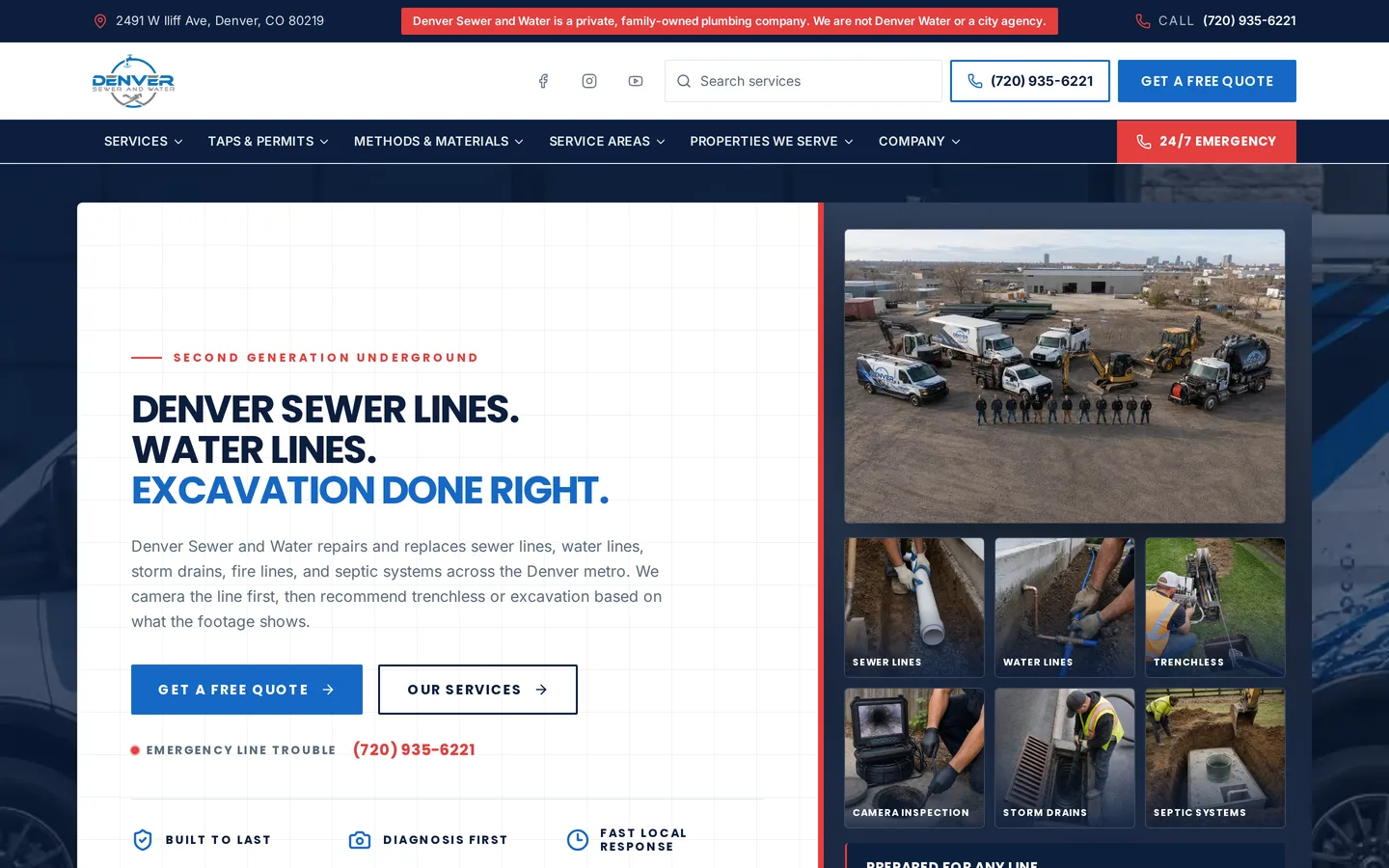
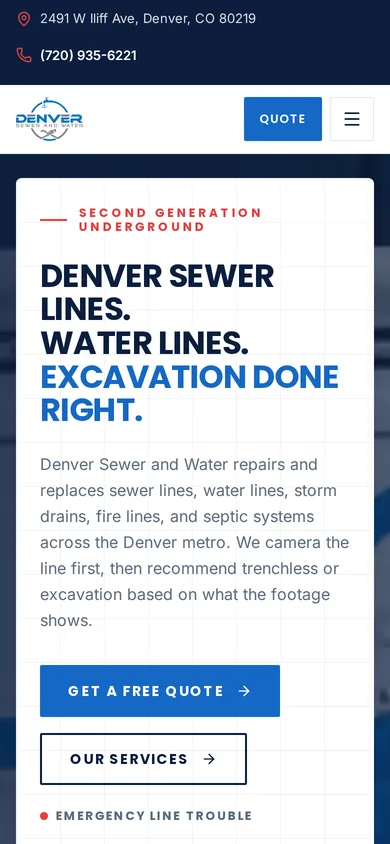
Denver Sewer and Water is a privately owned family underground line company in Denver. It is not affiliated with Denver Water or the City and County of Denver, and a large part of the site's job is making that clear while still winning the searches those names dominate.
A local trade business named after the city and the utility it works alongside inherits a specific problem. Half the search volume around its own name belongs to a municipal utility, and a homeowner with a broken sewer line at nine at night does not have patience for ambiguity about who they just called.
The brief
What the engagement had to deliver
Denver Sewer and Water came to us with a clear set of outcomes rather than a page count. Everything below was agreed before design started.
- Rebuild the site for a family owned underground line company
- Make the distinction from the municipal utility unmistakable without making it the whole message
- Win local search for the emergency and replacement work the company actually does
- Build server-rendered so service and locality pages are fully indexable
Key challenges
What made this build harder than a template
- Name collision with a municipal utility affects both search and the moment a visitor lands
- Underground line work is urgent and unglamorous, so the site has to be fast, clear and immediately actionable
- Emergency traffic arrives on a phone under stress, which sets a hard ceiling on how much design a page can carry
- Service area and service type both need coverage without generating thin duplicate pages
Our approach
How we built it
The build ran as a strict phase sequence starting from a verified blank scaffold, which for a local trade site matters more than it sounds, because the failure mode is a template that was never really understood. Ownership and independence are stated plainly and early rather than buried in an about page. Emergency paths are treated as the primary case: the phone number is always reachable, the action is always obvious, and nothing decorative sits between a stressed homeowner and a call. Service and locality content is structured to cover real search intent without spawning near-identical pages that compete with each other.
The front end
What visitors see
- Clear statement of private family ownership and independence from the municipal utility
- Emergency-first layout with the call action always reachable
- Service content structured by the work actually performed rather than by category padding
- Locality coverage built to avoid thin duplicate pages
- Server-side rendered for complete first-request HTML
- Full mobile treatment sized for a stressed homeowner on a phone
The stack
What it is built on
- TanStack Start
- React 19
- Tailwind v4
- shadcn/ui
- Server-side rendering on Cloudflare Workers
Results
What changed
- A clear identity separate from the municipal utility it is confused with
- Emergency traffic routed to a call in the fewest possible steps
- Service and locality content covering real intent without internal competition
- A local trade site built on an owned, server-rendered foundation
Since launch
Where the new enquiries come from
This company shares its name with a municipal utility, which historically made it hard to find deliberately. Since the rebuild the owner reports that assistants now distinguish the two correctly and send homeowners who understand they are calling a private family company.
What the client reports
- Callers who know the company is independent of the municipal utility before they call
- Emergency calls arriving with the problem already described in useful detail
- Assistants cited as the source of the recommendation
- Less time lost on the phone untangling who the caller thinks they reached
Why an answer engine can quote this site
- Ownership and independence stated plainly and early, in text an extractor can lift verbatim
- Service and locality pages cover real intent without spawning near-identical thin pages
- Server-rendered emergency information, so it is in the HTML on the first request
- One unambiguous statement of who the company is, repeated nowhere in a contradictory form
The points above are what the owner tells us, not analytics we audited on their behalf. We publish them as reported rather than dressing them up as measured numbers.
Common questions
Questions about the Denver Sewer and Water build
How does a local business compete for search terms a municipal utility dominates?
Not by fighting for the utility's own terms, which is unwinnable. By owning the service and problem language a homeowner actually types when something has failed, and by making the distinction obvious the moment they land.
What matters most on an emergency trade website?
Speed and an unmissable call action. A homeowner with a sewer backup is not evaluating design. Every element between them and the phone number is a cost.
How many service area pages should a local trade site have?
Only as many as can carry genuinely distinct content. Near-identical pages differing by city name compete with each other and dilute the whole set rather than expanding reach.
- Services
- Website, Local SEO, Design System
- Sector
- Underground Utilities
- Client
- Denver Sewer and Water
- Build window
- Phased build
Capabilities used
What this platform runs on
Building something similar in this sector? See the underground utilities platform guide, or read how a custom business operating system fits together, then book a discovery call.
Related work
Other platforms we have built
Septic Services
Affordable Septic Pumping
Affordable Septic Pumping is a family owned septic and grease trap services company in Westminster, Colorado. The site serves two completely different buyers, homeowners on a schedule or in an emergency, and commercial kitchens on a compliance cycle, without splitting into two sites.
Window Coverings
Blinds Couture
Blinds Couture came to us for a website. What shipped was a full operating system for a custom window covering business: a trade CRM, a deals pipeline, a booking engine with live availability, warranty claims, estimate-to-invoice approval, vendor document tracking, and two AI assistants, all sharing one database with the public site.
Metal Fabrication
Roseworks Fabrication
Roseworks Fabrication needed a site that treated custom metalwork as craft rather than as a commodity trade listing. It was built on the same design foundation as Blinds Couture, which let a proven premium system carry a second trade brand without starting over.
Want a site that works this hard for your business?
Bring us the workflow you are tired of duct taping together. We will show you what it looks like as one owned platform.