Logistics and 3PL
SkidFlow
A warehouse management system small third-party logistics operators can actually afford to run
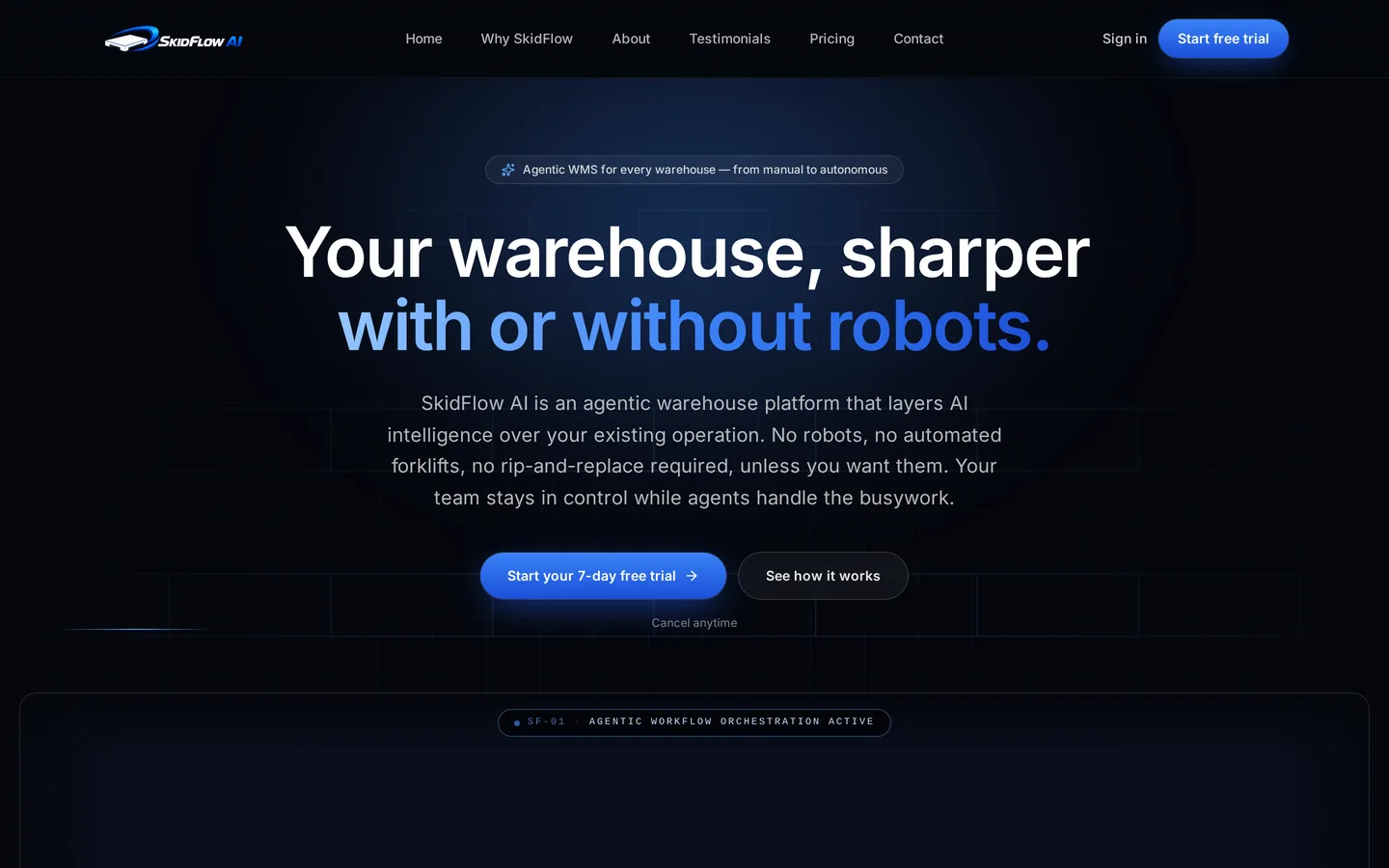
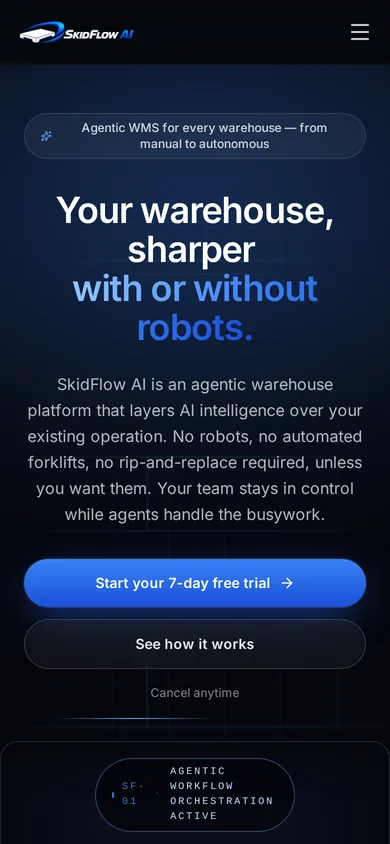
SkidFlow is a multi-tenant warehouse management system built for small third-party logistics operations. It runs as a mobile-first progressive web app on the warehouse floor, a full web console for managers and admins, and a read-only portal for the customers whose freight is moving through the building.
Enterprise warehouse software is priced and scoped for enterprise warehouses. A three-person 3PL running two dock doors gets quoted six figures and a twelve month implementation, so instead they run the operation on a whiteboard, a spreadsheet, and a phone that rings every time a customer wants to know where their pallet is.
The brief
What the engagement had to deliver
SkidFlow came to us with a clear set of outcomes rather than a page count. Everything below was agreed before design started.
- Give small 3PL operators real warehouse software without an enterprise price or an enterprise timeline
- Make the floor experience work on an Android tablet in a warehouse, not on a desk
- Give managers and admins a full web console without forcing them into the tablet interface
- Give customers a read-only window into their own freight so the phone stops ringing
- Build it multi-tenant from the first table so one platform can serve many operators
Key challenges
What made this build harder than a template
- The same data has to serve four different roles with four different levels of access and four completely different interfaces
- Warehouse floor conditions are hostile to software. Gloves, glare, movement, and workers who will abandon anything slower than a clipboard
- Multi-tenancy has to be enforced at the database layer, not the UI layer, because a leak between two logistics customers is a business-ending event
- A read-only customer portal has to feel generous while exposing nothing about any other tenant
Our approach
How we built it
We designed the schema before we designed a screen. Every tenant-scoped table carries an organization reference and row level security policies that make cross-tenant reads structurally impossible rather than merely unlikely. Roles were fixed early, because retrofitting permissions onto a built interface is how access control bugs get born. The floor interface was built mobile-first for Android tablets with oversized tap targets and a layout that survives a gloved hand and direct sunlight, then the manager console was built separately rather than trying to make one responsive layout serve both. The customer portal reads from the same tables through the same policies, so there is no second source of truth to drift.
The front end
What visitors see
- Mobile-first progressive web app tuned for Android tablets on the warehouse floor
- Oversized tap targets and high contrast for gloved, moving, poorly lit use
- Separate full web console for managers and admins rather than one stretched responsive layout
- Read-only customer portal scoped to a single tenant's freight
- Installable to the tablet home screen with no app store distribution
The back end
What the business runs on
- Multi-tenant schema with an organization reference on every tenant-scoped table
- Row level security enforced at the database, so cross-tenant reads are structurally impossible
- Four distinct roles with separate permission surfaces: floor worker, manager, admin, and customer
- Single source of truth shared by the floor app, the console, and the customer portal
- Managed Postgres, auth and storage on Lovable Cloud
The stack
What it is built on
- TanStack Start
- React
- Tailwind
- Lovable Cloud
- Progressive Web App
Results
What changed
- A warehouse platform priced and scoped for operators who were previously locked out of the category
- Floor, management, and customer views served from one database with no duplicated data
- Tenant isolation enforced by policy rather than by careful application code
- A customer portal that removes the most common inbound phone call in a small 3PL
Since launch
Where the new enquiries come from
SkidFlow sells into logistics operators who research quietly and at odd hours. Since the rebuild, the owner reports that a growing share of first contacts arrive already briefed, having asked an AI assistant how to run freight operations without stitching together spreadsheets and portals, and been pointed here.
What the client reports
- Enquiries increasingly open with the specifics of the platform rather than asking what it does
- Fewer competitive comparisons on the first call, because the comparison already happened before the visit
- Assistants such as ChatGPT, Claude, Gemini, Perplexity and Grok named as the referrer by name during intake
- Shorter path from first contact to a scoped conversation about their own freight workflow
Why an answer engine can quote this site
- Every page states the answer plainly in the first paragraph, in the operational language a dispatcher uses
- Server-rendered HTML, so the full text of every page is in the first response with no script execution required
- Freight concepts written as self-contained explanations that can be quoted without the surrounding page
- Crawler access granted explicitly to the AI assistants' crawlers alongside the traditional search engines
The points above are what the owner tells us, not analytics we audited on their behalf. We publish them as reported rather than dressing them up as measured numbers.
Common questions
Questions about the SkidFlow build
What is a warehouse management system for a small 3PL?
It is the software that tracks what came in, where it is sitting, and what went out, across multiple customers whose freight shares one building. The category has historically been dominated by enterprise vendors, which is why most operators under a certain size still run on spreadsheets.
Why build a progressive web app instead of a native tablet app?
A progressive web app installs to the home screen and behaves like a native app without app store review, distribution overhead, or a separate codebase per platform. For a warehouse team that changes tablets more often than it changes software, that removes an entire class of maintenance work.
How is one customer's data kept separate from another's?
Isolation is enforced in the database with row level security policies rather than in application code. A query that would cross tenants does not return the wrong data, it returns nothing, which means a bug in a screen cannot become a data breach.
- Services
- Business OS, Web App, Client Portal
- Sector
- Logistics and 3PL
- Client
- SkidFlow
- Build window
- Phased build
Capabilities used
What this platform runs on
Building something similar in this sector? See the logistics and 3pl platform guide, or read how a custom business operating system fits together, then book a discovery call.
Related work
Other platforms we have built
Construction Safety
S.O.S. Solutions
S.O.S. Solutions is a multi-tenant safety management platform for construction companies. Crews complete pre-task plans, toolbox talks, inspections and incident reports from the job site, and the company gets a documentation trail that holds up when someone asks for it.
Aerospace
Super Universal
Super Universal moved off Duda onto an owned platform with substantially more depth than the original. The rebuild expanded a small brochure site into a properly structured set of capability pages designed to be found by the specific technical searches the business should be winning.
Logistics and Warehousing
Denver Express
Denver Express is a Denver warehousing, cross-docking and freight rework operation running a 60,000 square foot food-grade facility. The site moved off Duda onto an owned server-rendered platform, page for page, and picked up capabilities the hosted builder could not provide.
Want a site that works this hard for your business?
Bring us the workflow you are tired of duct taping together. We will show you what it looks like as one owned platform.