Children's Publishing
Bookworms Publishing
A child talks to an AI story friend and a printed keepsake book arrives in the mail
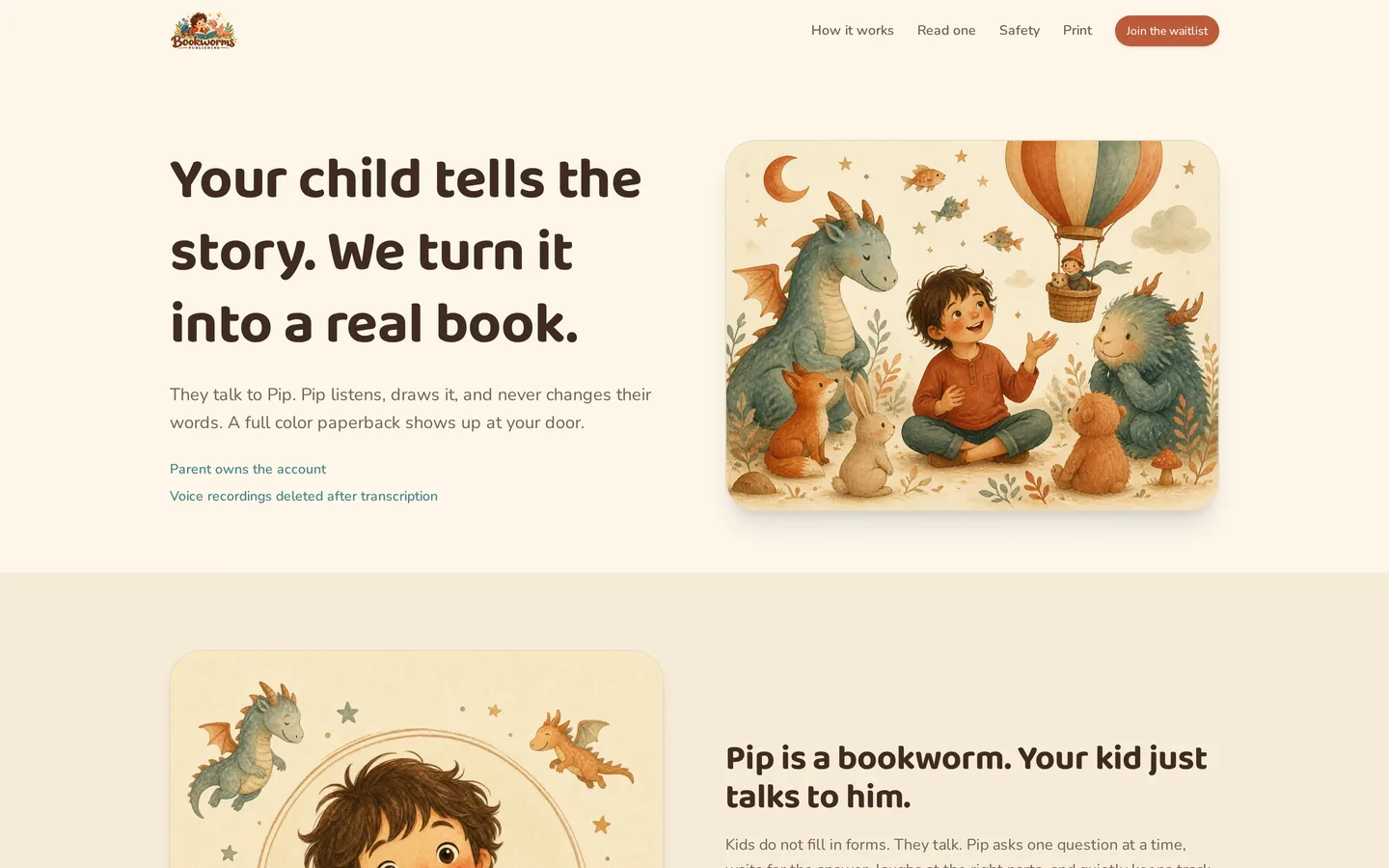
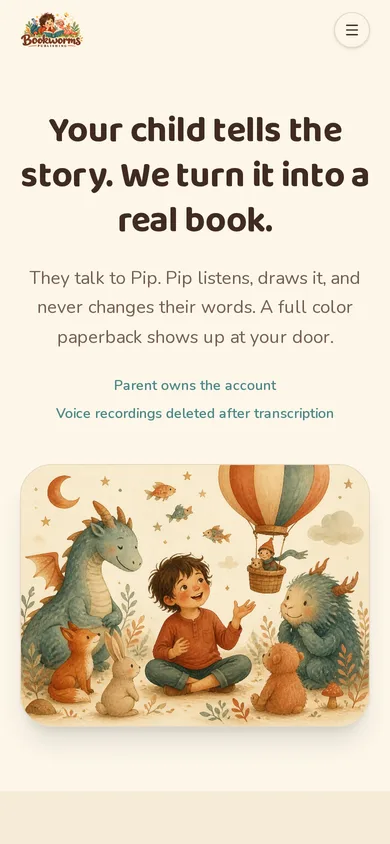
Once Upon a Me is a voice-driven storybook creator. A child between three and ten speaks their imagination to an AI story friend named Pip, who co-creates a twenty-four page picture book with them. A parent then reviews it, pays, adds a private inside-cover message, and a printed keepsake ships.
Children's creativity tools mostly generate content for children rather than with them. The output is polished and the child's actual voice is nowhere in it, which means the artifact is a product rather than a memory. The thing worth keeping is the part most tools quietly replace.
The brief
What the engagement had to deliver
Bookworms Publishing came to us with a clear set of outcomes rather than a page count. Everything below was agreed before design started.
- Let a child aged three to ten create a book by speaking rather than typing
- Preserve the child's own creative voice rather than smoothing it into generated prose
- Put a parent in control of review, payment and the private message before anything prints
- Produce a physical keepsake, not a file
Key challenges
What made this build harder than a template
- The primary user cannot reliably read, type, or navigate an interface, which rules out most conventional UI patterns
- Preserving a child's voice while producing a coherent twenty-four page narrative is a genuine tension, and resolving it toward polish would defeat the entire product
- Two users with different needs, a child creating and a parent approving and paying, in one product
- Anything involving children requires the parent gate to be structural rather than a checkbox
Our approach
How we built it
Voice is the interface because the primary user cannot type. Pip functions as a collaborator rather than a generator, prompting and building alongside the child so the finished book still contains the child's own ideas rather than a model's improvement of them. That restraint is the product. The parent surface is separated cleanly: review, payment, and the private inside-cover message all live behind the adult, and nothing prints until an adult has seen it. Commerce runs on Lovable Cloud with Stripe, and the print handoff is treated as the final step of the story rather than a separate transaction.
The front end
What visitors see
- Voice-driven creation flow built for a child who cannot reliably read or type
- Pip as a conversational story collaborator rather than a content generator
- Twenty-four page picture book assembled from the child's own contributions
- Separate parent review surface with approval before anything prints
- Private inside-cover message added by the parent
- Checkout and print handoff completing the story rather than interrupting it
The back end
What the business runs on
- Story, page and asset model backing the twenty-four page book structure
- Voice capture and AI orchestration for the collaborative creation flow
- Parent and child treated as distinct roles with a structural approval gate
- Stripe checkout for the printed keepsake
- Lovable Cloud for data, auth and asset storage with row level security
The stack
What it is built on
- TanStack Start
- React 19
- Tailwind v4
- shadcn/ui
- Lovable Cloud
- Stripe
Results
What changed
- A creative tool where the child's own voice survives into the finished artifact
- An interface a pre-reader can use without adult operation
- Parent approval enforced structurally rather than by a confirmation checkbox
- A physical keepsake as the output rather than a downloadable file
Since launch
Where the new enquiries come from
Once Upon a Me is a new kind of product, so parents ask an assistant to explain it before they buy. The team reports that assistant-referred parents arrive with the concept already understood and move straight to trying it.
What the client reports
- Parents arriving able to describe how the story session works before starting one
- Questions about safety and parental review rather than about what the product is
- Assistants named directly as the source of the recommendation
- Shorter path from first visit to a completed story session
Why an answer engine can quote this site
- The product is explained as a sequence of concrete steps, which is exactly what an assistant can summarise
- Safety, review and privacy answered explicitly rather than implied
- Server-rendered pages so the explanation is in the HTML, not built after load
- Every claim written to be checkable, which keeps it safe for an assistant to repeat
The points above are what the owner tells us, not analytics we audited on their behalf. We publish them as reported rather than dressing them up as measured numbers.
Common questions
Questions about the Bookworms Publishing build
How does a child too young to read use a software product?
By speaking. Voice removes the reading and typing requirement entirely, which is what makes the product usable by a three-year-old without a parent operating it for them.
How do you keep AI from taking over a child's story?
By designing the AI as a collaborator rather than a generator. The system prompts and assembles rather than improving, because a polished story the child did not actually make is not worth printing.
Why does a parent have to approve the book?
Because a child is the user and a parent is the customer, and anything involving children needs the adult gate built into the flow rather than added as a checkbox. Nothing prints until an adult has read it.
- Services
- Business OS, Web App, AI Platform, Commerce
- Sector
- Children's Publishing
- Client
- Bookworms Publishing
- Build window
- Phased build
Capabilities used
What this platform runs on
Read how a custom business operating system fits together, then book a discovery call.
Related work
Other platforms we have built
Direct to Consumer
Rip the Labels
Rip the Labels is a keepsake guided journal for women, sold direct. The brand moved off Shopify onto a platform it owns, carrying the full commerce path, product pages, cart, Stripe checkout and order confirmation, plus payment monitoring most storefronts never get.
Faith Community
The Herd
The Herd is a membership platform for a men's ministry community. It carries accounts, membership billing and community programming, but it was deliberately built to feel like a premium brand site rather than a church application, because the men it is trying to reach would not download a church application.
AI Software
MentorOS
MentorOS is an AI mentorship platform built around a life domains framework and a persistent memory layer. Conversations carry forward across sessions using vector memory, so the mentor builds a picture of the person over months rather than restarting from zero every time the tab closes.
Want a site that works this hard for your business?
Bring us the workflow you are tired of duct taping together. We will show you what it looks like as one owned platform.