Direct to Consumer
Rip the Labels
A luxury journal brand that left Shopify and took its checkout with it
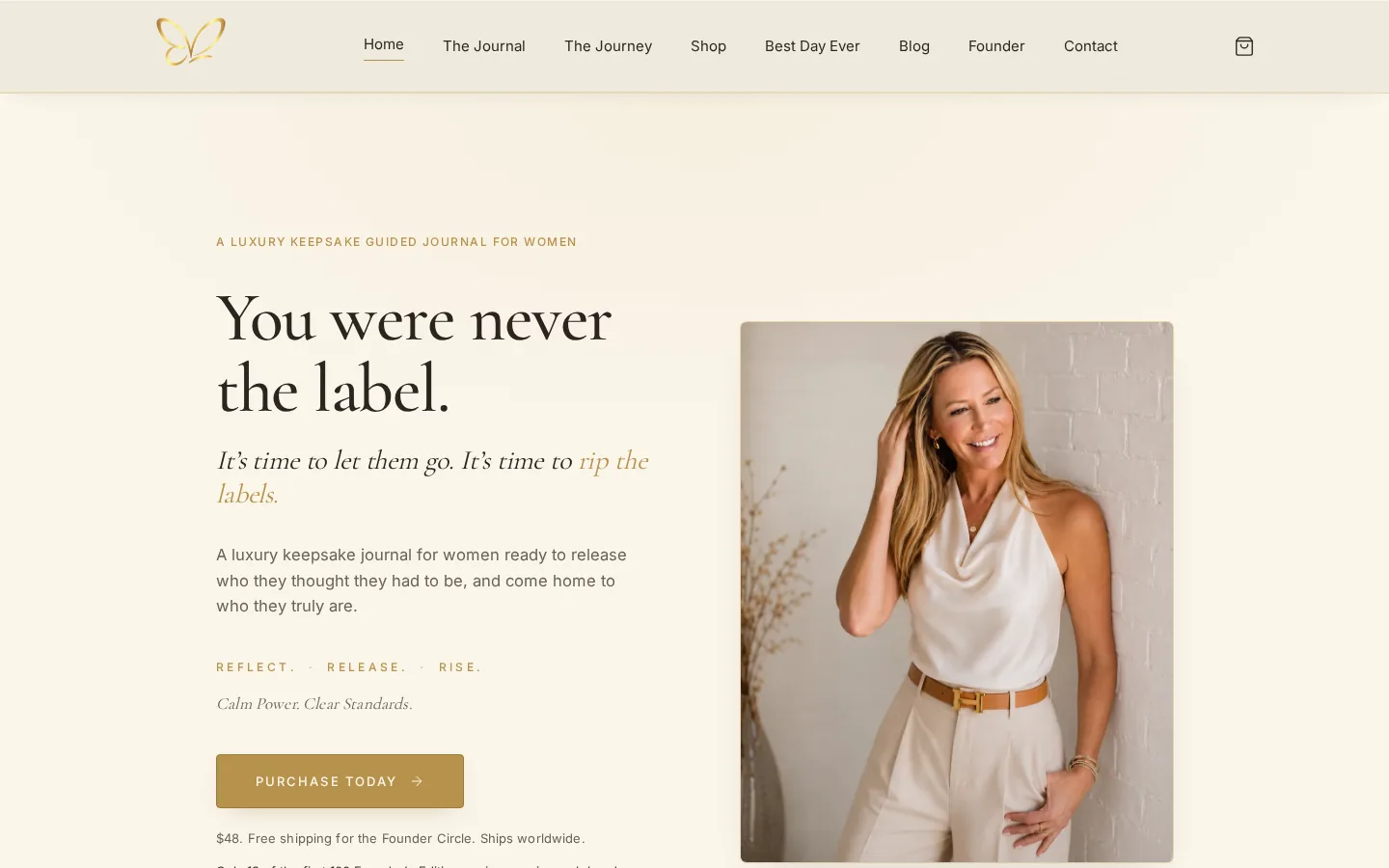

Rip the Labels is a keepsake guided journal for women, sold direct. The brand moved off Shopify onto a platform it owns, carrying the full commerce path, product pages, cart, Stripe checkout and order confirmation, plus payment monitoring most storefronts never get.
Shopify is excellent at being Shopify. It is not excellent at being a specific brand. A product priced as a keepsake, with a founder voice and a limited founding edition, gets flattened into the same template as everything else in the theme store, and the brand pays a percentage forever for the privilege.
The brief
What the engagement had to deliver
Rip the Labels came to us with a clear set of outcomes rather than a page count. Everything below was agreed before design started.
- Rebuild the storefront to match a genuinely premium product rather than a theme
- Carry the full commerce path off Shopify without losing conversion
- Hold a strict brand voice: no wellness cliches, no hype punctuation, no em dashes
- Own the checkout and the customer data outright
Key challenges
What made this build harder than a template
- Replacing a hosted commerce platform means rebuilding cart, checkout, order handling and confirmation, all of which Shopify gives away and all of which have to be correct
- A cream and gold palette with a serif display face is a narrow visual band. Any coarseness in spacing or weight shows immediately
- Payment failures on a self-hosted checkout are invisible unless you build the visibility yourself
- The founder voice was locked and non-negotiable, so generated copy had to match a specific human rather than a brand guideline
Our approach
How we built it
The design system came first and was treated as locked: cream, oat and warm neutrals, a single gold family, Cormorant Garamond for display against Inter for body, generous section spacing, and sharp card edges because rounded reads cheaper at this price point. Commerce runs on Lovable Cloud with Stripe handling payment directly. Then we built the part most self-hosted stores skip. External TLS and SSL health checks, synthetic monitoring from multiple networks, a public status page, and an internal dashboard tracking every Stripe checkout attempt and webhook outcome with alerting on failure. On a hosted platform you file a support ticket. Here we see the failure before the customer does.
The front end
What visitors see
- Full storefront with shop, product detail, cart, checkout and order confirmation
- Locked design system in cream, oat and gold with a serif display face and script accents
- Founder and brand narrative pages carrying a strict, specific voice
- Reservation landing page for the founding edition
- Editorial and blog surface
- Public status page for service transparency
- Full mobile treatment with a stacked checkout
The back end
What the business runs on
- Product, order, and customer data on Lovable Cloud with row level security
- Stripe checkout with webhook handling for order fulfilment
- Internal dashboard tracking every checkout attempt and webhook outcome
- Automated alerting on payment failure rather than discovery by customer complaint
- External TLS and SSL health checks with synthetic monitoring across multiple networks
- Email capture wired to the list rather than to a form endpoint
The stack
What it is built on
- TanStack Start
- React 19
- Tailwind v4
- shadcn/ui
- Lovable Cloud
- Stripe
Results
What changed
- A storefront that reads as the brand rather than as a theme
- Checkout, customer data and order history owned outright instead of rented
- Payment failures surfaced by monitoring instead of by a customer who could not buy
- No per-transaction platform fee on top of payment processing
Common questions
Questions about the Rip the Labels build
Is it worth leaving Shopify for a custom storefront?
It depends on margin and brand. For a low-margin, high-SKU catalog, Shopify's economics are hard to beat. For a small catalog at a premium price, where the brand experience is the product, the percentage stops making sense quickly and the template becomes the constraint.
What do you lose by building your own checkout?
You lose the platform absorbing the operational burden, which is real. That is why this build includes payment monitoring, webhook tracking and failure alerting. If you take on the checkout you have to take on the visibility, or you will find out about outages from customers.
Can a custom store handle payments as securely as a hosted platform?
Card data goes directly to Stripe and never touches the application, which is the same model most hosted platforms use underneath. The security question is really about who is watching the pipeline, which is why monitoring was built in rather than added later.
- Services
- Website, Commerce, Design System, Monitoring
- Sector
- Direct to Consumer
- Client
- Rip the Labels
- Build window
- Phased build
Capabilities used
What this platform runs on
Building something similar in this sector? See the direct to consumer platform guide, or read how a custom business operating system fits together, then book a discovery call.
Related work
Other platforms we have built
Children's Publishing
Bookworms Publishing
Once Upon a Me is a voice-driven storybook creator. A child between three and ten speaks their imagination to an AI story friend named Pip, who co-creates a twenty-four page picture book with them. A parent then reviews it, pays, adds a private inside-cover message, and a printed keepsake ships.
Window Coverings
Blinds Couture
Blinds Couture came to us for a website. What shipped was a full operating system for a custom window covering business: a trade CRM, a deals pipeline, a booking engine with live availability, warranty claims, estimate-to-invoice approval, vendor document tracking, and two AI assistants, all sharing one database with the public site.
Membership Organization
NOCO Women's Chamber
The NOCO Women's Chamber needed a site that works as a recruitment surface first and a member utility second. The visual system was derived from the organization's rose gold badge, carrying a metallic quality into a digital design language that usually flattens it.
Want a site that works this hard for your business?
Bring us the workflow you are tired of duct taping together. We will show you what it looks like as one owned platform.