AI Software
MentorOS
An AI mentor that remembers you, wrapped in an interface that does not look like a chatbot
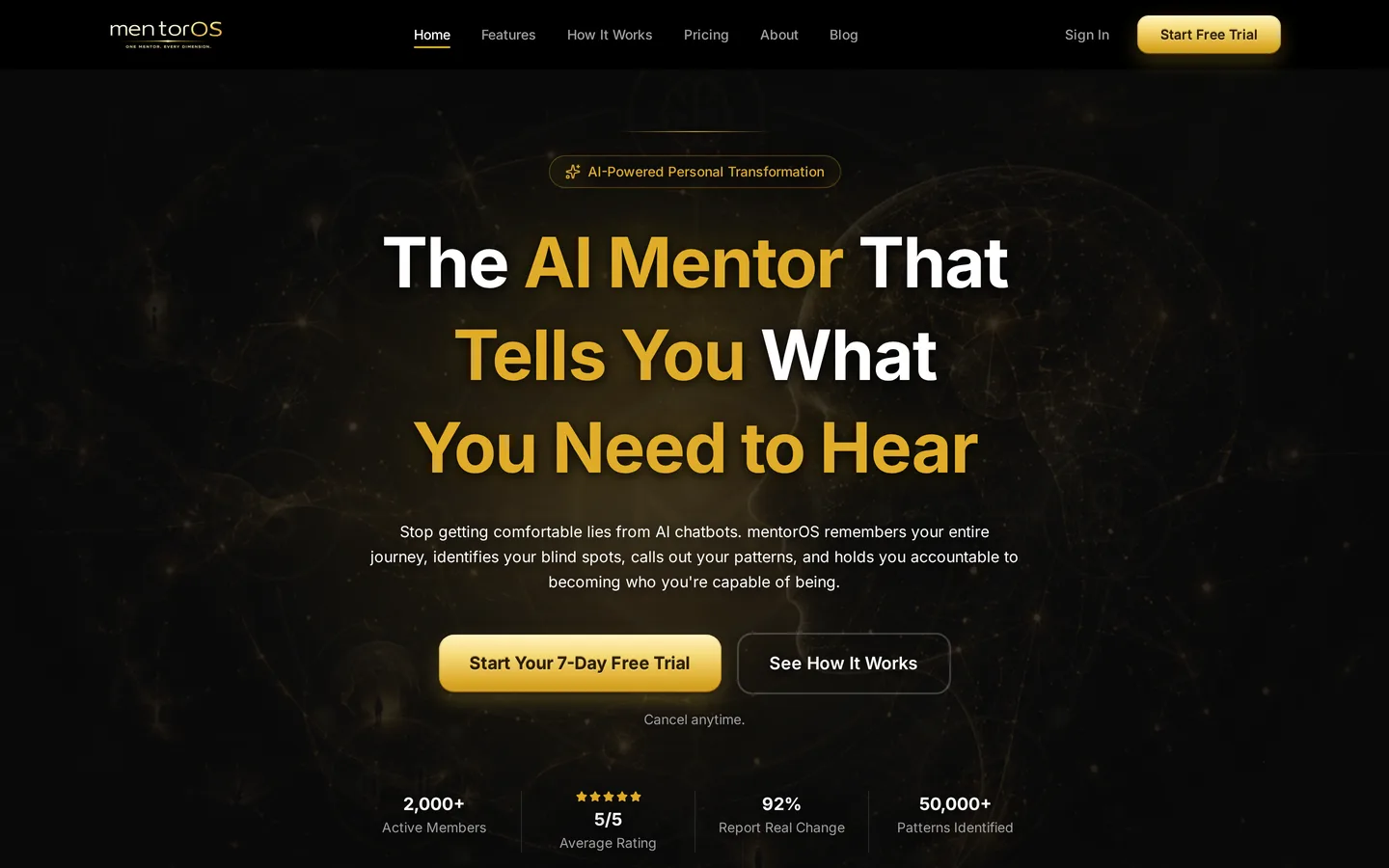
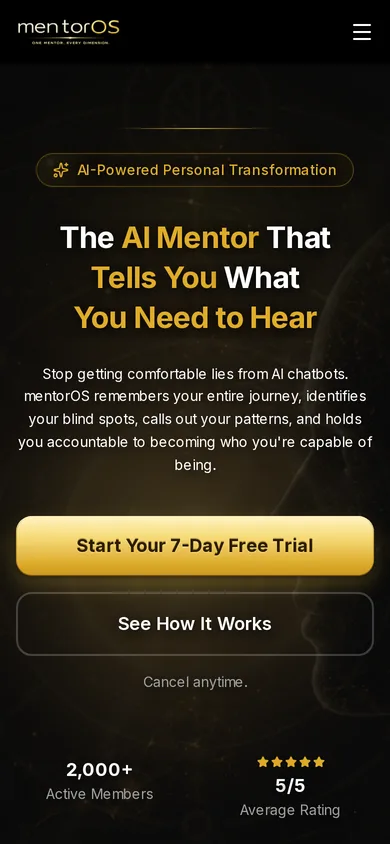
MentorOS is an AI mentorship platform built around a life domains framework and a persistent memory layer. Conversations carry forward across sessions using vector memory, so the mentor builds a picture of the person over months rather than restarting from zero every time the tab closes.
Most AI mentorship products are a chat box with a system prompt. They forget you between sessions, they treat career and health and relationships as one undifferentiated blob, and they look like every other wrapper shipped that quarter. None of that survives contact with someone actually trying to change their life.
The brief
What the engagement had to deliver
MentorOS came to us with a clear set of outcomes rather than a page count. Everything below was agreed before design started.
- Build a mentorship product that remembers the person across sessions rather than restarting each time
- Structure guidance around distinct life domains instead of one general-purpose conversation
- Reach a visual bar closer to a private banking product than a consumer AI app
- Keep the interface calm enough that someone will actually sit with a hard question
Key challenges
What made this build harder than a template
- Persistent memory is the entire product, and it is the hardest part to build well. Too little recall feels broken, too much feels invasive
- Structured life domains have to organize the experience without turning it into a form
- A dark, gold-accented luxury palette is unforgiving. Every spacing and weight decision shows
- The interface has to feel unhurried while the model underneath is doing meaningful work
Our approach
How we built it
Memory came first. Conversations are embedded and stored as vectors so the mentor can retrieve what is genuinely relevant to the current question rather than replaying an entire transcript into context. That is what makes a session feel like continuing a relationship instead of briefing a stranger. The life domains framework gives the product its spine, letting the same underlying mentor hold distinct threads for the areas of someone's life that do not actually resolve into one conversation. The visual language runs deliberately minimal: generous space, restrained typography, a single gold accent against a dark ground, nothing decorative competing with the words on screen.
The front end
What visitors see
- Minimalist luxury interface built on a dark palette with a single restrained gold accent
- Life domains framework organizing guidance into distinct threads
- Deliberate typographic hierarchy and generous spacing throughout
- Conversation surface designed to feel unhurried rather than transactional
- Fully server-rendered so the marketing surface is readable to search and answer engines
The back end
What the business runs on
- Vector memory using pgvector, so past conversations are retrieved by relevance rather than replayed wholesale
- Persistent user context carried across sessions and across domains
- Dedicated Supabase instance with row level security on every user-scoped table
- Structured domain model backing the life domains framework
The stack
What it is built on
- TanStack Start
- React 19
- TanStack Router
- Tailwind v4
- Supabase with pgvector
Results
What changed
- A mentorship product where the second conversation is materially better than the first
- Guidance organized by life domain rather than collapsed into a single chat history
- An interface that reads as a premium product rather than a model wrapper
- A memory architecture that scales with the length of the relationship instead of degrading
Since launch
Where the new enquiries come from
MentorOS is an AI product, and its buyers ask AI what to buy. Since launch the team reports that assistant-referred visitors behave differently from search visitors: they arrive knowing the positioning and asking about fit rather than about category basics.
What the client reports
- New contacts referencing explanations they read before arriving, in the site's own words
- Conversations starting at implementation rather than at what the product category is
- Assistant referrals reported alongside conventional search as a first-touch source
- Less time spent defending the concept, more spent on the customer's own use case
Why an answer engine can quote this site
- Answer-first structure: the direct answer sits above the supporting argument on every page
- Terminology defined once, in one canonical place, and linked to rather than restated
- Server rendering means no metadata or body copy depends on the browser running JavaScript
- Headings phrased as the questions a buyer actually types, so the extractable unit matches the query
The points above are what the owner tells us, not analytics we audited on their behalf. We publish them as reported rather than dressing them up as measured numbers.
Common questions
Questions about the MentorOS build
How does an AI mentor remember previous conversations?
Past conversations are converted into vector embeddings and stored in the database. When a new question comes in, the system retrieves the most semantically relevant prior context rather than replaying the entire history, which keeps responses grounded without exhausting the model's context window.
What is pgvector and why use it here?
It is a Postgres extension that stores and searches vector embeddings directly in the database. Keeping memory in the same database as the rest of the application means no separate vector service to operate, secure, and keep in sync.
What is a life domains framework?
Rather than one general conversation, guidance is organized into the distinct areas of a person's life that do not actually resolve into each other. It lets the same mentor hold separate threads without collapsing them into a single undifferentiated history.
- Services
- Business OS, AI Platform, Design System
- Sector
- AI Software
- Client
- MentorOS
- Build window
- Phased build
Capabilities used
What this platform runs on
Building something similar in this sector? See the ai software platform guide, or read how a custom business operating system fits together, then book a discovery call.
Related work
Other platforms we have built
Hospitality Technology
NobleHost AI
NobleHost AI answers the phone for hotels, luxury yachts and cruise lines in more than forty languages. The site had to sell an AI voice product to an industry that measures itself on human warmth, so the product demonstrates itself in the hero rather than being described.
Faith Community
The Herd
The Herd is a membership platform for a men's ministry community. It carries accounts, membership billing and community programming, but it was deliberately built to feel like a premium brand site rather than a church application, because the men it is trying to reach would not download a church application.
Logistics and 3PL
SkidFlow
SkidFlow is a multi-tenant warehouse management system built for small third-party logistics operations. It runs as a mobile-first progressive web app on the warehouse floor, a full web console for managers and admins, and a read-only portal for the customers whose freight is moving through the building.
Want a site that works this hard for your business?
Bring us the workflow you are tired of duct taping together. We will show you what it looks like as one owned platform.